Getting Started
Introduction to Composting
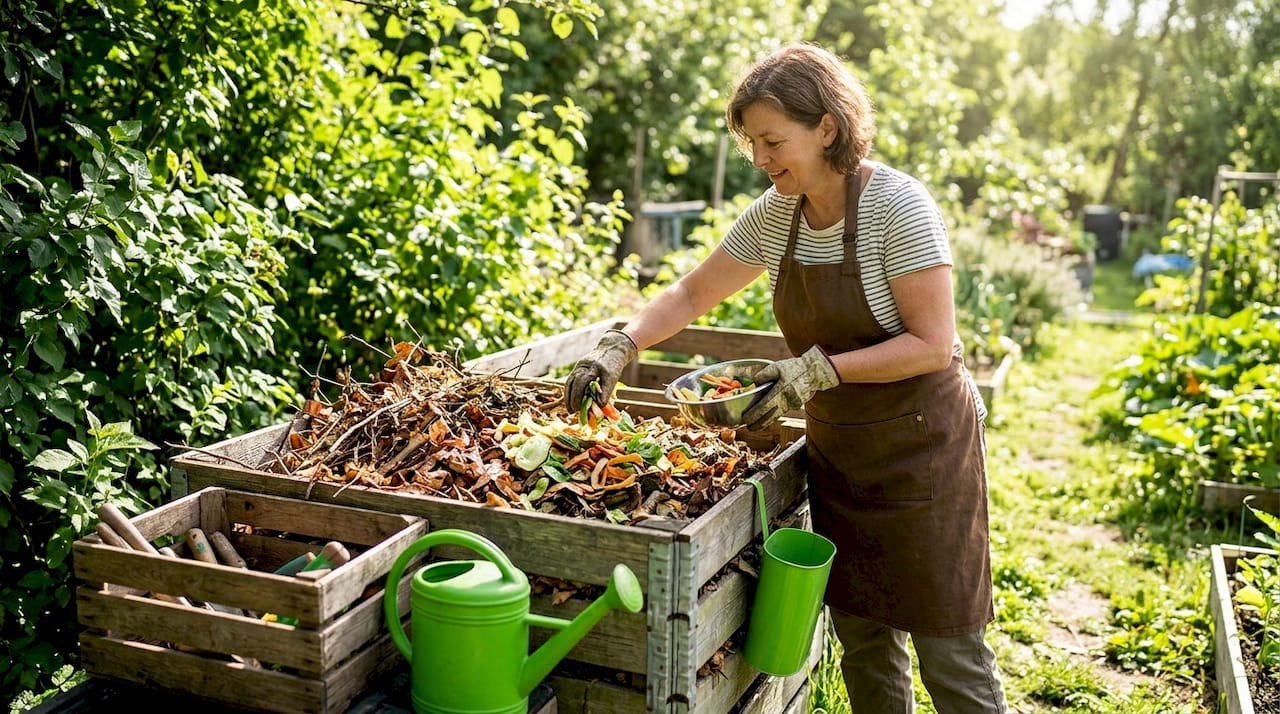
“Compost” is both a noun (the finished stuff) and a verb (the process). Finished compost is dark, crumbly, and smells like a forest floor. It is a soil amendment first — it raises organic matter, water-holding, and biology — and a mild fertilizer second. A well-managed pile often shrinks 40–60% as bacteria work. You should not feel you must compost in order to garden organically; you can buy compost. Making it closes a loop, kills many weed seeds if the pile runs hot, and can even suppress some soil diseases.
Pseudocomposting — heaping weeds in a corner — decays slowly, may harbor more weeds, and kitchen scraps in an open heap attract raccoons. Cover scraps with leaves, cardboard, or newspaper if that is all you can do this year.
Four conditions the pile needs
Size. A cube about 3 ft on a side is the usual minimum to hold heat. Cities compost in windrows hundreds of feet long; you do not need that. Air. Bacteria that make sweet compost need oxygen. Bins need holes. Turn the pile every 1–2 weeks for speed, or wait a year. A sour, slimy heap is anaerobic — add browns and turn. Water. The pile should feel like a wrung-out sponge. If it is dry 6–12 inches in, water into poked holes, not just the crust. Carbon-to-nitrogen. Microbes want roughly 25–30 parts carbon to 1 part nitrogen by weight. In practice: two to three volumes of browns for every one volume of greens. “More greens than browns” makes a wet, smelly heap. Do not average C:N labels like (20+20+60)/3 and call it a recipe — mix materials.
What goes in
Greens (nitrogen-rich, usually moist): fruit and vegetable scraps, coffee grounds, fresh grass clippings, plant trimmings without seed, seaweed, alfalfa.
Browns (carbon-rich, usually dry): dry leaves, straw, shredded cardboard, paper, small twigs, pine needles, unfinished wood chips in moderation. Wood chips can run 300–600:1 carbon; they need a lot of greens or they sit.
Keep out: meat and dairy unless you run a hot, managed pile; pet waste; glossy colored paper; diseased plants you do not want to gamble on; and human manure. A beginner handbook is not the place to build a humanure system. Do not add dog or cat feces.