Getting Started
Watering
Beginners tend to overwater (so do some experienced gardeners). Watering matters in three situations: (1) crops are growing, weather is warm, and it has not rained for 1–2 weeks; (2) you have just transplanted and rain is not likely within 24 hours; (3) you have just seeded and rain is not likely within a week. In the first case you may water the whole garden. In the second and third, water only the new plants or seed.
Most vegetables want about 1 inch of water a week, including rain. One deep watering beats a daily sprinkle. Wet the root zone 5–6 inches (12–15 cm), then let the top inch dry slightly. Deep water makes deep roots. Shallow sprinkles make shallow roots. Overwater and roots drown; underwater and you get blossom-end rot, bitterness, and bolted greens.
The squeeze test
If you are not sure, pull back mulch and dig 4–5 inches down. Squeeze soil from the bottom of the hole into a ball. If it sticks, you do not need to water — unless you have a bed of tiny seedlings with short roots. If it will not ball, water. Sandy soil never forms a ball; if it sticks to your fingers, it is wet enough.
How to apply it
Getting water 5–6 inches down can take a long time. Most gardeners water too shallowly. There is no single timer setting, but dry soil may need an hour or more, depending on the method. Standing with a hose over the whole garden is a recipe for giving up too soon. A quick hand watering is fine for a few seeds or transplants in already-moist soil.
Water until the soil is moist to depth — not until it is muddy or standing. Unless you are using drip on very dry ground, watering all night is a bad idea.
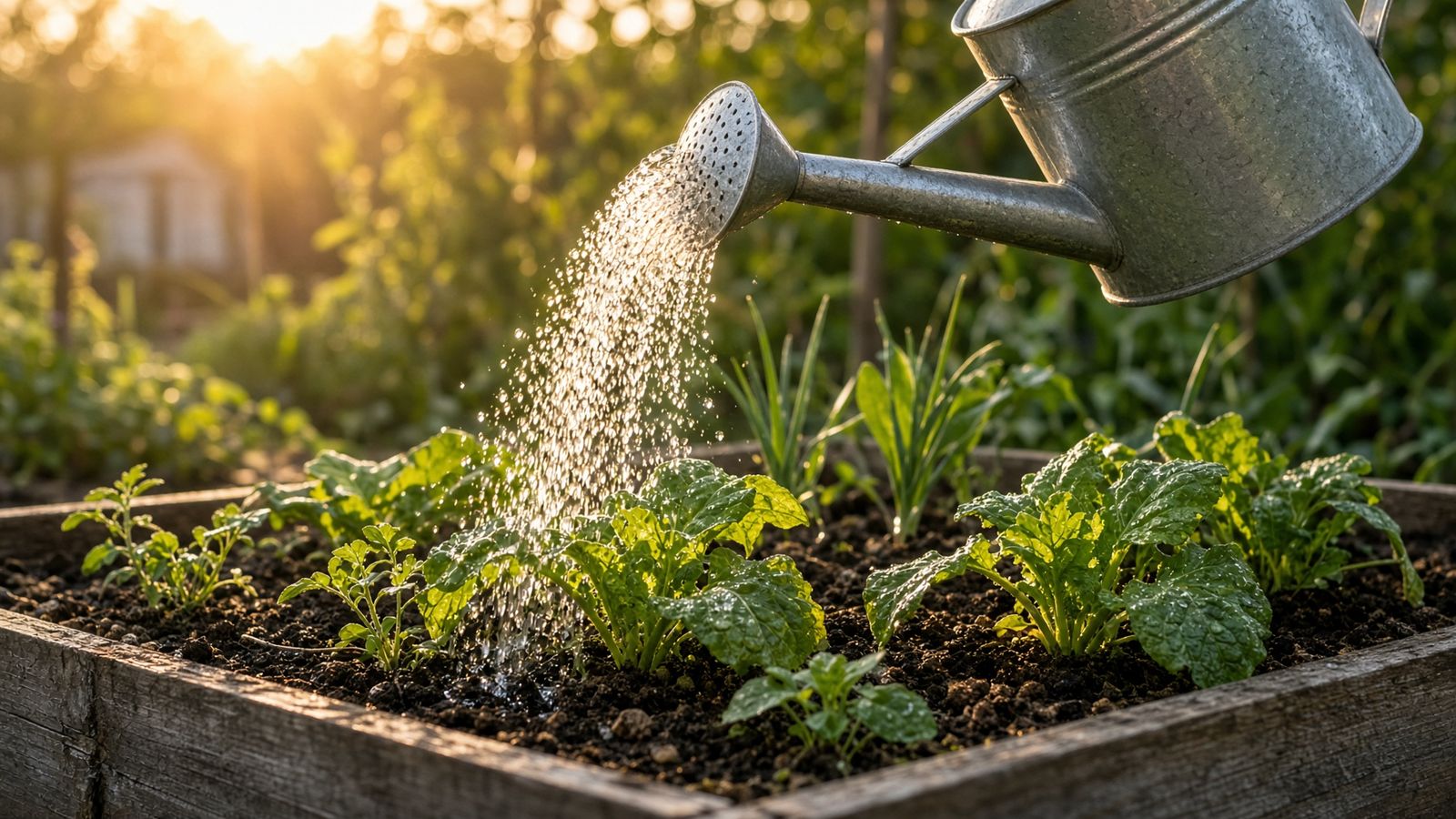
Three ways: by hand, with an overhead sprinkler, or with drip / soaker hose at the surface. Hand watering uses a hose with a rose or wand. Buy all-metal if you can; most plastic guns fail. An open hose blasts seed out of the row.
Overhead sprinklers are simple and wasteful — a lot of water evaporates before it hits the ground. Midday watering in heat can lose as much as 80%. Water in the morning (before 9 or 10 a.m.) or evening (after 5 or 6 p.m.) so leaves dry. Fixed sprinklers throw a set square or circle. Oscillating sprinklers sweep a rectangle. Rotary (impulse) sprinklers throw a circle. They are not interchangeable. Prefer metal parts.
Drip hoses have holes on one side at regular intervals. Soaker hoses weep all around. Drip is usually better. Both use less water than sprinklers, do not wet leaves (so they do not feed leaf diseases), and can run even at midday. Arrange the hose to cover what you want wet, and let it run slowly.
How you know — and winter
Finger in the soil, second knuckle, is the daily shortcut. Plants that wilt at noon and recover by evening are often just heat-stressed; plants that wilt in the morning are thirsty or drowning. Check the soil before you guess.
Put hoses and sprinklers away before a hard freeze, under cover, out of sun and wind. Mulch holds water in the soil and cuts how often you need to irrigate.